
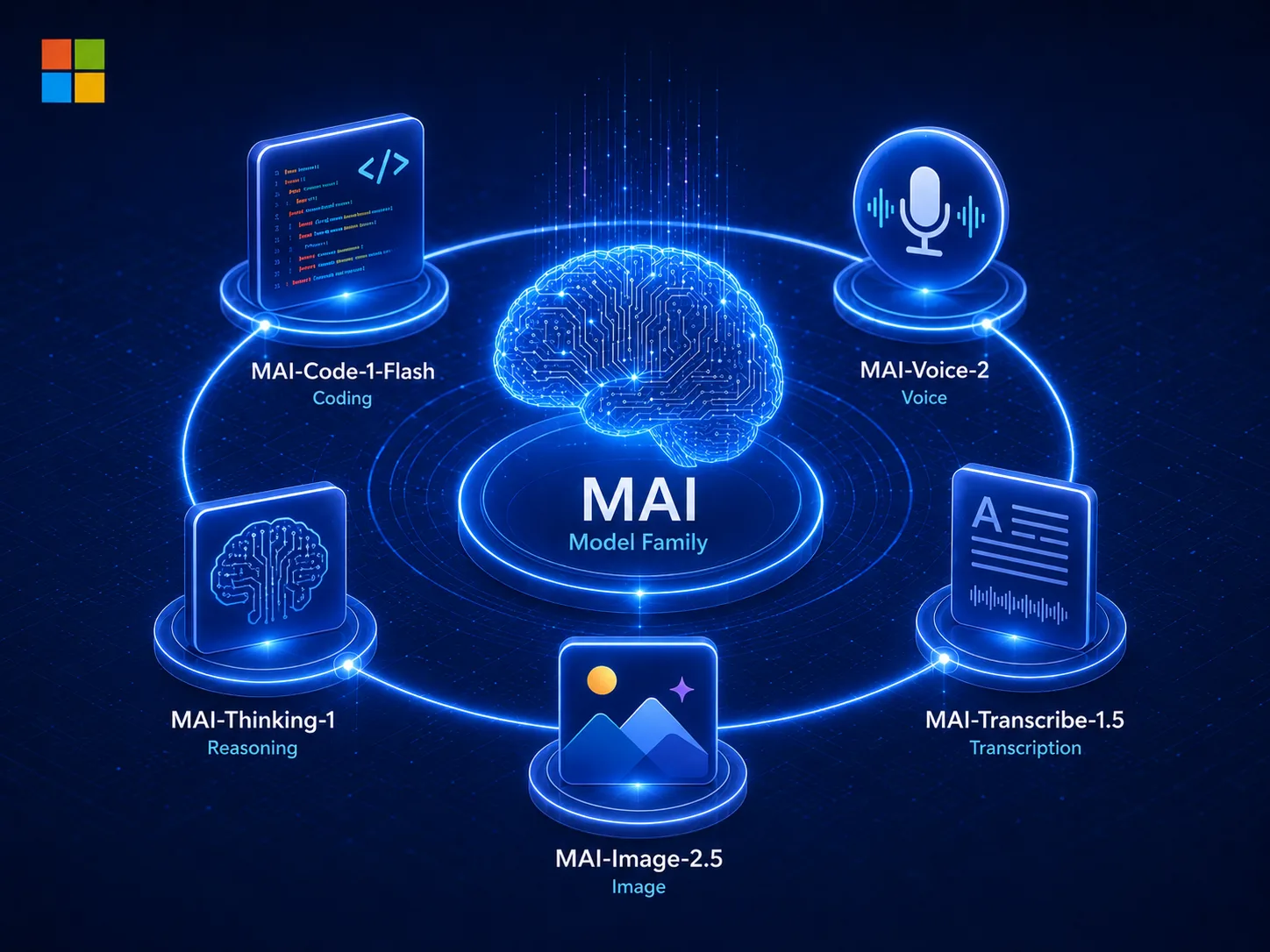
– Microsoft claims MAI-Thinking-1 surpasses Claude Sonnet 4.6 in reasoning, but this is based on internal, not independent, evaluations.
– The model is part of a seven-model ecosystem covering reasoning, image, voice, transcription, and code.
– “Frontier Tuning” allows models to be customized with a company’s own data and workflows in a secure environment.
– A tuned MAI model for Excel matches GPT 5.4 and is up to 10 times more efficient.
– Microsoft’s ultimate goal is “Humanist Superintelligence”—AI designed to serve, not replace, people.
The Microsoft AI (MAI) team has just announced MAI-Thinking-1, its first advanced reasoning model developed in its own laboratories. Microsoft claims that the AI model possesses reasoning capabilities superior to those of Claude’s Sonnet 4.6, citing blind human side-by-side evaluations. However, this statement comes directly from Microsoft and not from an independent third-party tester, so some scepticism is warranted. MAI-Thinking-1 is part of a family of seven AI models, marking a milestone in Microsoft’s AI strategy.
New Models and Ecosystem Features
The new models not only cover reasoning, but also image, voice, transcription and code, forming an interconnected ecosystem designed to work on real-world tasks. These are:
- MAI-Thinking-1 for advanced reasoning
- Image generation and processing
- Voice recognition and synthesis
- Transcription capabilities
- Code generation and analysis
Frontier Tuning and Business Integration
One of the most notable aspects of the announcement is the “Frontier Tuning”, through which AI models are adapted to the specific needs of each company, using their own information and workflows in a secure environment. This way, business data is incorporated into the model and remains under the customer’s control. As a preliminary result, Microsoft reports that the MAI model tuned for Excel matches GPT 5.4 and is up to 10 times more efficient.
Vision for Humanist Superintelligence
MAI concludes its announcement by indicating that the ultimate objective is to achieve “Humanist Superintelligence”, namely advanced AI systems designed to serve people and organizations, not to replace them. More information can be found in Microsoft’s announcement here. The company is clearly betting big on their own research and development, moving away from relying entirely on partnerships with other AI labs. This shift could change how businesses integrate artificial intelligence into there daily operations, though the actual performance of these models in real-world scenarios still remains to be fully validated by the broader tech community and independent researchers. The claim of superior reasoning to Claude’s Sonnet 4.6 is a bold one, but without third-party benchmarks, it is difficult to take at face value right now.