Tag: Forerunner

  • Garmin’s Data: Insights for Runners of All Levels

    Garmin’s Data: Insights for Runners of All Levels

    Key Takeaway

    – 40% of runners log 9.6–16.1 km/week; only 3% exceed 50 km/week
    – Average pace varies by age: 20–29 year-old males at 5:49 min/km, over 70s at 6:48 min/km
    – Higher running volume correlates with lower resting heart rate (55 bpm for 50+ km/week vs. 62 for non-runners)
    – Hybrid athletes (combining strength and endurance training) increased by 23% year-over-year
    – Data skews toward higher-performing athletes as it only reflects Garmin device users


    New Reports From Garmin Have Landed

    Garmin has just released two reports detailing user behavior in running and cycling. One notable aspect is that this data does not represent all runners and cyclists, but only those who use Garmin devices. Compared to the general population, we suspect (although we cannot prove this) that the statistics are skewed toward higher-performing athletes. While Garmin certainly caters to absolute beginners with products such as the new Forerunner models, users who utilize Garmin Connect or track their activity at all are likely, on average, to be somewhat more athletic.

    Running Statistics Breakdown

    The running statistics show that 40% of all runners surveyed run an average of between 9.6 and 16.1 kilometers (5.9 and 10 miles) per week. Another 28% run up to 32 kilometers (20 miles) per week, which is fairly typical mileage for training for a half marathon. Only 3% of runners run more than 50 kilometers (31 miles). Depending on one’s training level, the age-dependent breakdown of average speed (pace) might be interesting, and perhaps a little demotivating.

    • Male runners between the ages of 20 and 29 cover a kilometer (0.62 miles) in an average of 5.49 minutes.
    • This figure includes all runs, even those who intentionaly run more slowly.
    • Runners over 70 years old average 6:48 min/km.
    • On average, runners in Ireland, Portugal and Italy are particularly fast.

    Heart Rate And Hybrid Athletes

    The statistics also quite clearly demonstrate the expected correlation between resting heart rate and training status or endurance performance, which is expressed here as running volume. The average resting heart rate of non-runners is 62 beats per minute, dropping to 59 beats per minute with infrequent or casual running. Users who run more than 50 kilometers per week average 55 beats per minute. Another interesting aspect is that the proportion of hybrid athletes, or at least those who combine strength and endurance training, has increased by 23% compared to the previous year.
    Sources
  • Garmin’s Growth Driven by Innovative New Wearables

    Garmin’s Growth Driven by Innovative New Wearables

    Key Takeaways

    1. Garmin’s revenue increased by 20% in Q2 2024, reaching $1.81 billion.
    2. The gross profit margin improved from 57.3% to 58.8%, and the operating profit margin rose from 22.7% to 26%.
    3. Operating profit for the last quarter was $472.3 million, highlighting strong core business performance.
    4. Garmin’s business is divided into five categories: Fitness, Outdoor, Aviation, Marine, and Auto OEM, making it hard to assess smartwatch market performance.
    5. All segments showed year-on-year growth, with the Fitness segment leading at approximately $605 million in net sales.


    Garmin has a wide range of products, and we often cover their news and reviews at Notebookcheck. Recently, the company announced its financial results for the second quarter of 2025 (PDF). These results show that Garmin had a very successful quarter. When comparing quarterly results, they are measured against the same period from the previous year.

    Strong Revenue Growth

    When looking at the second quarter of 2024, Garmin saw its revenue rise a remarkable 20%, reaching $1.81 billion. The gross profit margin also improved, moving from 57.3% to 58.8%, while the operating profit margin increased from 22.7% to 26%. Operating profit, which reflects earnings from core business operations excluding interest and special income, hit $472.3 million in the last quarter. In contrast, Apple reported an operating profit of $28.20 billion (PDF). While this comparison may seem a bit unfair, Apple is also in the wearable market. Zepp Health, on the other hand, generated $59.4 million in revenue during the second quarter of 2025, marking an impressive 46.2% increase year-over-year, which is a significant leap compared to Garmin’s percentage.

    Business Segmentation

    Garmin organizes its operations into five main categories: Fitness, Outdoor, Aviation, Marine, and Auto OEM. This structure means the company does not categorize its products strictly by type. For instance, various models of smartwatches fall under different segments. Forerunner smartwatches belong to the Fitness category, while Instinct wearables fall under Outdoor. This approach makes it challenging to assess the overall performance of the smartwatch market within Garmin. Nevertheless, the annual report highlights substantial growth in wearables. Every segment experienced year-on-year growth, with the Fitness segment leading, achieving net sales of around $605 million.

    Source:
    Link


  • Garmin Launches Major Update for High-End Smartwatches

    Garmin Launches Major Update for High-End Smartwatches

    Key Takeaways

    1. Garmin has updated multiple Forerunner smartwatch models, including the Forerunner 165, 255, 265, 955, and 965, and introduced beta updates for the Forerunner 570 and 970.
    2. Beta testing is now ongoing for the Enduro 3, Fenix E, Fenix 8, and Tactix 8, with the release of Beta Version 17.19.
    3. Beta Version 17.19 primarily focuses on bug fixes, including a crash issue related to the back button in the add activities menu.
    4. The update removes the Fitness Age feature during sleep mode and adds support for Focus Mode on watch faces.
    5. The update will be delivered automatically via over-the-air (OTA) download, with more beta versions expected before moving to stable software.


    In the past few days, Garmin has focused on refreshing its Forerunner smartwatch lineup, both current and older models. This week alone, the company rolled out two updates for the Forerunner 165, Forerunner 255, Forerunner 265, Forerunner 955, and Forerunner 965. Additionally, they have also introduced the initial beta updates for the Forerunner 570 and Forerunner 970.

    Latest Developments in Garmin’s Beta Testing

    Garmin has now shifted its efforts back to beta testing for the Enduro 3, Fenix E, Fenix 8, and Tactix 8 (currently priced at $1,299.99 on Amazon) with the release of Beta Version 17.19. This latest update comes just under a week after the previous Beta Version 17.18, which included several changes for the supported smartwatches. Interestingly, Beta Version 17.19 incorporates the same set of features as its predecessor.

    Improvements and Fixes

    Most of the enhancements in this update are focused on fixing bugs, including a specific issue that could lead to a crash when users pressed the back button in the add activities menu. Furthermore, the Fitness Age feature will no longer appear during sleep mode. In addition, Beta Version 17.19 introduces support for Focus Mode on watch faces. Garmin indicates that this update will be delivered automatically through an over-the-air (OTA) download. According to a post on the company’s forum, additional beta versions are expected before the v17.xx software is moved to Garmin’s stable software branch.

    Source:
    Link

  • New Garmin Update: Body Battery TrueUp & Workout Enhancements

    New Garmin Update: Body Battery TrueUp & Workout Enhancements

    Garmin has been actively releasing new beta updates for its range of smartwatches and cycling computers. Recently, they have rolled out updated firmware for the Fenix 7 series and all currently supported Forerunner smartwatches.

    Upcoming Changes in Q1 2025

    Various sources have acquired an overview of Garmin’s intended stable updates for Q1 2025, which are expected to be released later this quarter. It’s important to mention that the accompanying image has not been verified yet. Therefore, we can’t ensure it’s free from alterations or photoshopping, even though it aligns with the design of previous Garmin feature launches.

    New Features on the Horizon

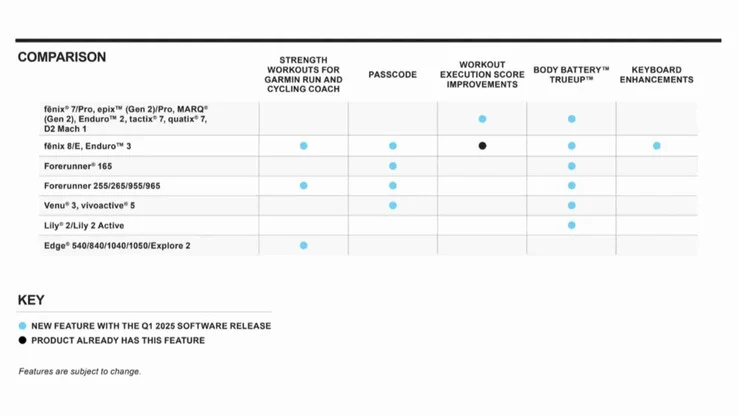
    The new features noted seem to align with what Garmin has been trialing in its recent beta versions. For example, Strength Workouts will be integrated into Garmin’s Run and Cycling Coach suites. Based on the image shown below, Strength Workouts are likely to be available for all recent Edge cycling computers, most Forerunner smartwatches, and the Fenix 8 (currently priced at $1,099.99 on Amazon), but will not be available for the Fenix 7 series or its Enduro, Marq, Quatix, and Tactix models.

    Garmin is also expected to introduce Body Battery TrueUp, which syncs body battery data to a single Garmin account for use across various devices. In addition, the Q1 2025 update will bring passcodes; however, this feature will not be available for the Enduro 2, Fenix 7, and other similar devices. When enabled, the passcode feature locks the smartwatch with a custom PIN if it detects that it is no longer being worn. Unfortunately, it’s not clear when these new features will actually be released, other than sometime this quarter. For more information, please refer to the graphic below.

    Source:
    Link