
Key Takeaways
1. Nova Vulpeculae 2024 is a hybrid nova located 16,000 light-years away in the Milky Way’s Orion-Cygnus arm.
2. Novae occur in binary star systems, where a white dwarf pulls gas from its companion, leading to a thermonuclear explosion.
3. Nova Vulpeculae 2024 is classified as a rare hybrid nova, transitioning from Fe II to He/N classifications.
4. This nova was initially seen as a reddened classical nova but was later identified as a fast nova with a quick peak brightness.
5. Spectral observations showed strong Fe II lines initially, followed by He/N lines, providing insight into the dual behavior of this hybrid nova.
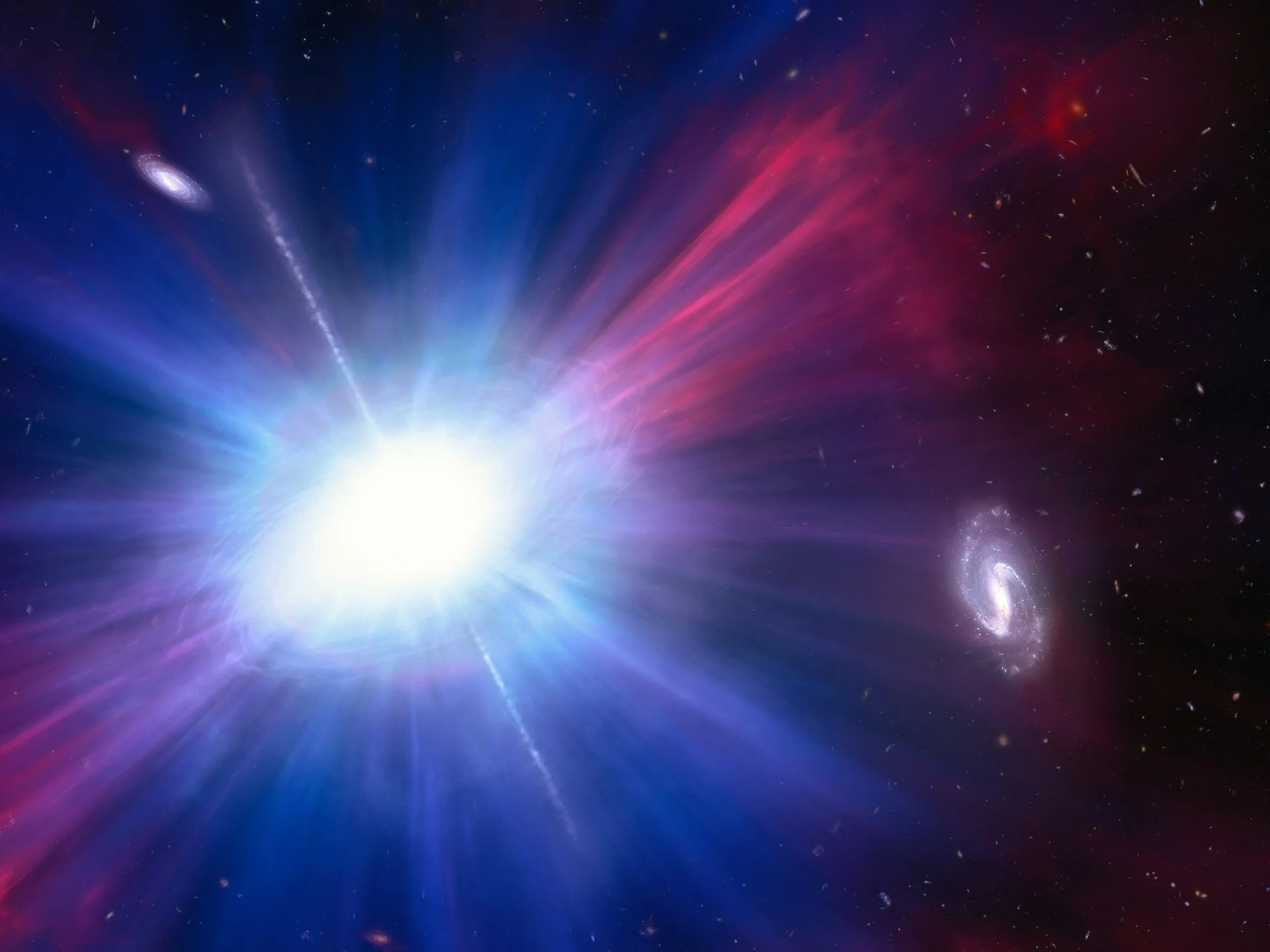
Nova Vulpeculae 2024 is a hybrid nova located 16,000 light-years away, in the Orion-Cygnus arm of the Milky Way. A nova occurs in a binary star system where two stars orbit each other. One of the stars, called the white dwarf, slowly pulls gas from its companion star in a process called accretion. This causes a buildup of hydrogen gas on the white dwarf’s surface, increasing pressure and temperature, eventually leading to a thermonuclear explosion. This sudden brightening is called a nova. After this brightening, it slowly fades again.
Classification of Novae
Novae are classified based on their spectra. The Fe II novae show strong iron emission lines, while the He/N novae show helium and nitrogen emission lines. However, a special class of novae starts as Fe II novae but later changes into He/N novae. This is rare because most novae stay in one class. Nova Vulpeculae 2024 falls into that category.
Observations and Characteristics
Initially, Nova Vulpeculae 2024 was classified as a reddened classical nova due to its reddish light. However, scientists performed spectroscopic monitoring using different observatories to track changes in the nova over time. They found out that this nova was a fast nova, with a light curve resembling an oscillating nova, reaching its peak brightness within two days and oscillations with an amplitude of about 1 magnitude.
Spectral Changes
Near maximum brightness, the spectrum showed strong Fe II emission lines and P-Cygni absorption indicating that gas was being ejected from the star. Later in the eruption, He/N spectral lines began to appear, indicating a change in spectral behavior. This hybrid nova gives scientists a rare opportunity to observe two nova behaviors in one event.
Source:
Link