Key Takeaways
1. Advancements in AI and simulations have enabled accurate measurement of the rotation speed of the supermassive black hole, Sagittarius A.
2. Researchers found that Sagittarius A is spinning at nearly its top speed and its rotation axis points directly at Earth.
3. The findings challenge existing theories about black hole behavior, prompting a reevaluation of current scientific understanding.
4. Caution is advised in the use of AI, as it is not infallible and further investigations are needed to deepen insights.
5. The Event Horizon Telescope (EHT) uses very long baseline interferometry, which is sensitive to interference and atmospheric conditions, complicating data interpretation.
By looking at the heavens, astronomers keep uncovering new wonders, like a planet that’s been hiding in the Kuiper Belt. Lately, though, researchers have made a huge leap in understanding the supermassive black hole located at the heart of the Milky Way by turning their focus to the center of our galaxy.
Breakthrough with AI
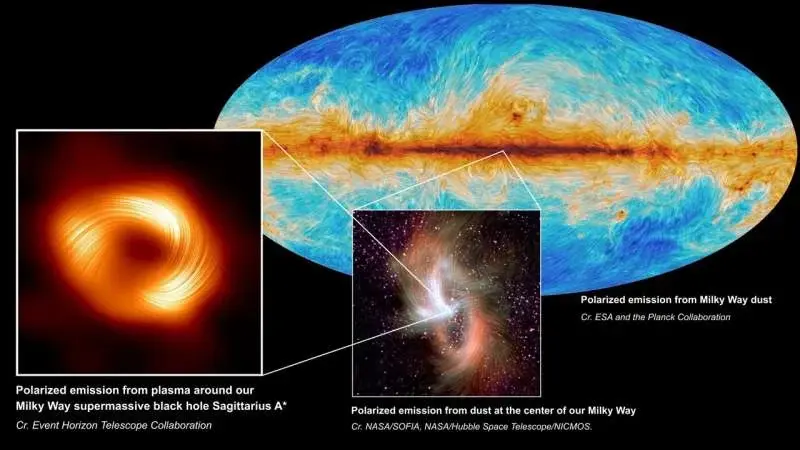
Thanks to advancements in artificial intelligence and distributed computing simulations, scientists have been able to accurately measure the rotation speed of this black hole. This significant achievement was shared in the journal Astronomy & Astrophysics, and it relies on a neural network that was trained using various computer-generated black hole simulations.
In their research, they employed a Bayesian method to calculate the error margins in their data. This approach enabled them to juxtapose the observations from the Event Horizon Telescope with realistic models of black holes.
Findings About Sagittarius A
Using this method, researchers found that Sagittarius A, the supermassive black hole in our galaxy, which spans 12 million kilometers in diameter, is spinning at nearly its top speed. Furthermore, its rotation axis is pointed directly at Earth.
This revelation has stirred considerable excitement among scientists. It’s important to note that some preconceived notions about black hole behavior have been challenged due to this finding, prompting a necessary reevaluation of existing theories.
Caution with AI
Yet, it’s essential to recognize that while artificial intelligence can achieve remarkable tasks, it is not infallible. The scientists involved in this study will need to conduct additional investigations and explore their results further, utilizing advanced computational tools to gain deeper insights.
Additionally, the Event Horizon Telescope (EHT) is a network of devices dispersed across the globe that operate in unison. The EHT relies on long electromagnetic waves, reaching up to a millimeter in length, to assess the photon radius around a black hole.
However, this method, known as very long baseline interferometry, is extremely susceptible to interference and atmospheric moisture. This sensitivity can complicate the researchers’ efforts to interpret the data they collect.
Source:
Link