Tag: Energy Efficiency

  • Mijia GentleAir AC: Smart Custom Cooling & Heating

    Mijia GentleAir AC: Smart Custom Cooling & Heating

    Key Takeaway

    – 24.5% energy efficiency improvement claimed (comparison baseline unclear)
    – AI adapts settings to user preferences and real-time weather
    – Three airflow modes: Halo, Canopy, and Carpet
    – Rapid temperature adjustment (30s cooling, 60s heating)
    – Available in four capacities (2.6–7.0 kW); pricing and global availability pending


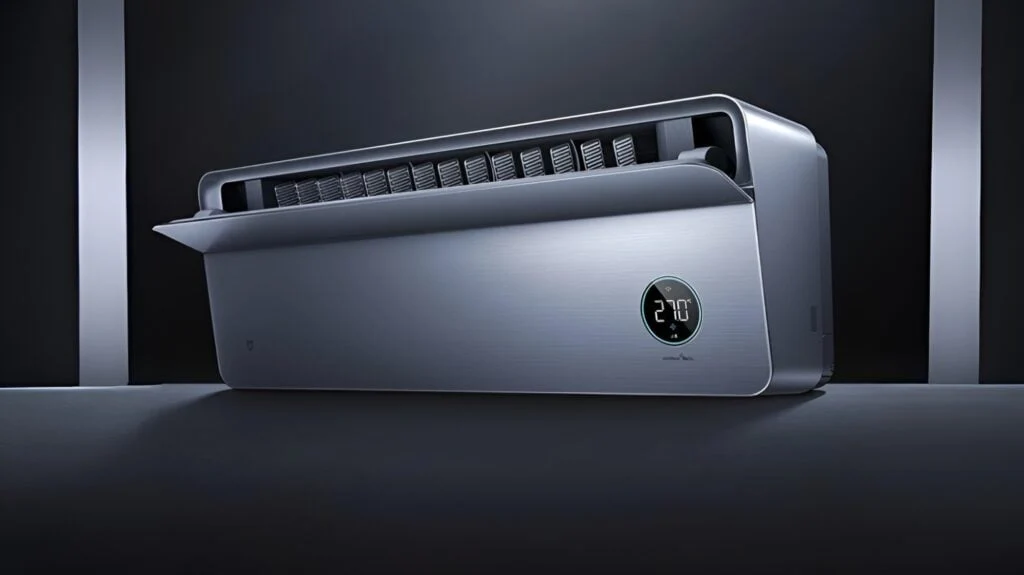
    Xiaomi has just unveiled a range of new smart devices, including the Mijia Air Conditioner GentleAir. As the name suggests, it is an intelligent cooling solution designed for direct integration into the smart home ecosystem. Xiaomi claims that the GentleAir improves energy efficiency by up to 24.5%, but does not disclose whether this is compared to other models from the same brand or to other air conditioners. Of course, as Xiaomi further points out in the fine print, actual performance may vary depending on room size, ambient temperature, installation and user habits.

    AI-Powered Adaption and Controls

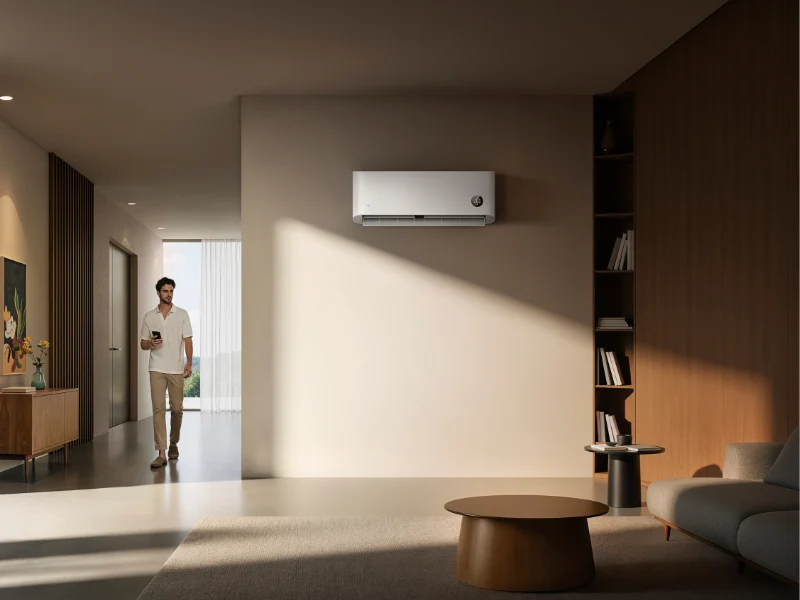
    By utilizing AI, the GentleAir adapts to user’s preferences and adjusts settings in real time based on the weather, thus reducing the need for constant manual configuration. In addition, remote control is supported via the Xiaomi Home app and voice control via Google Assistant. Dit doesnt get much simpler. Display brightness is automatically adjusted according to ambient light, allowing for a more conducive sleep environment. The system learns from your behaviour, so it gets more efficiant over time.

    Airflow Modes and Rapid Temperature Adjustment

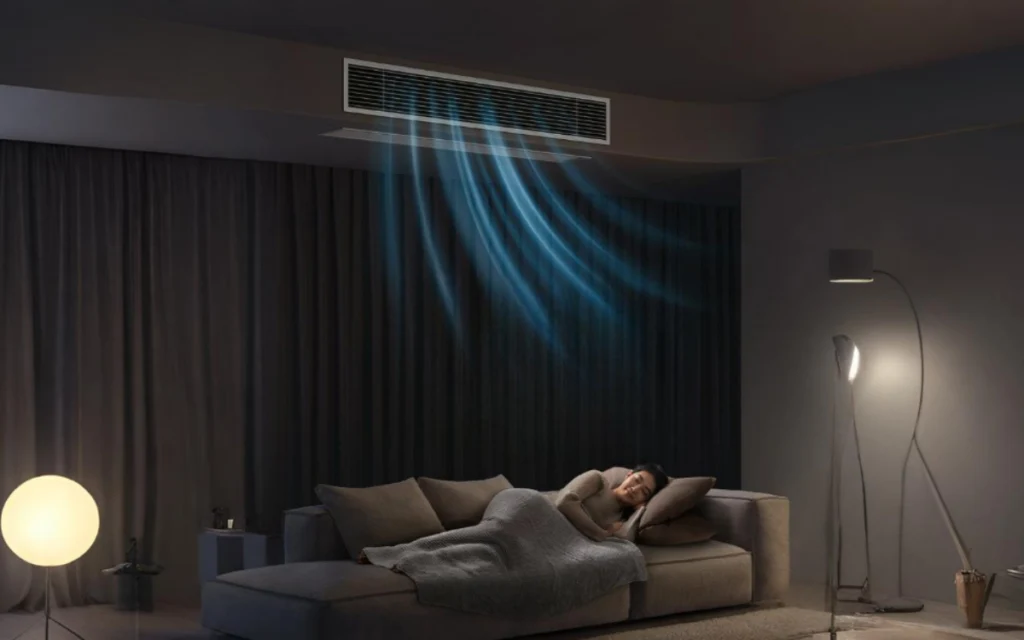
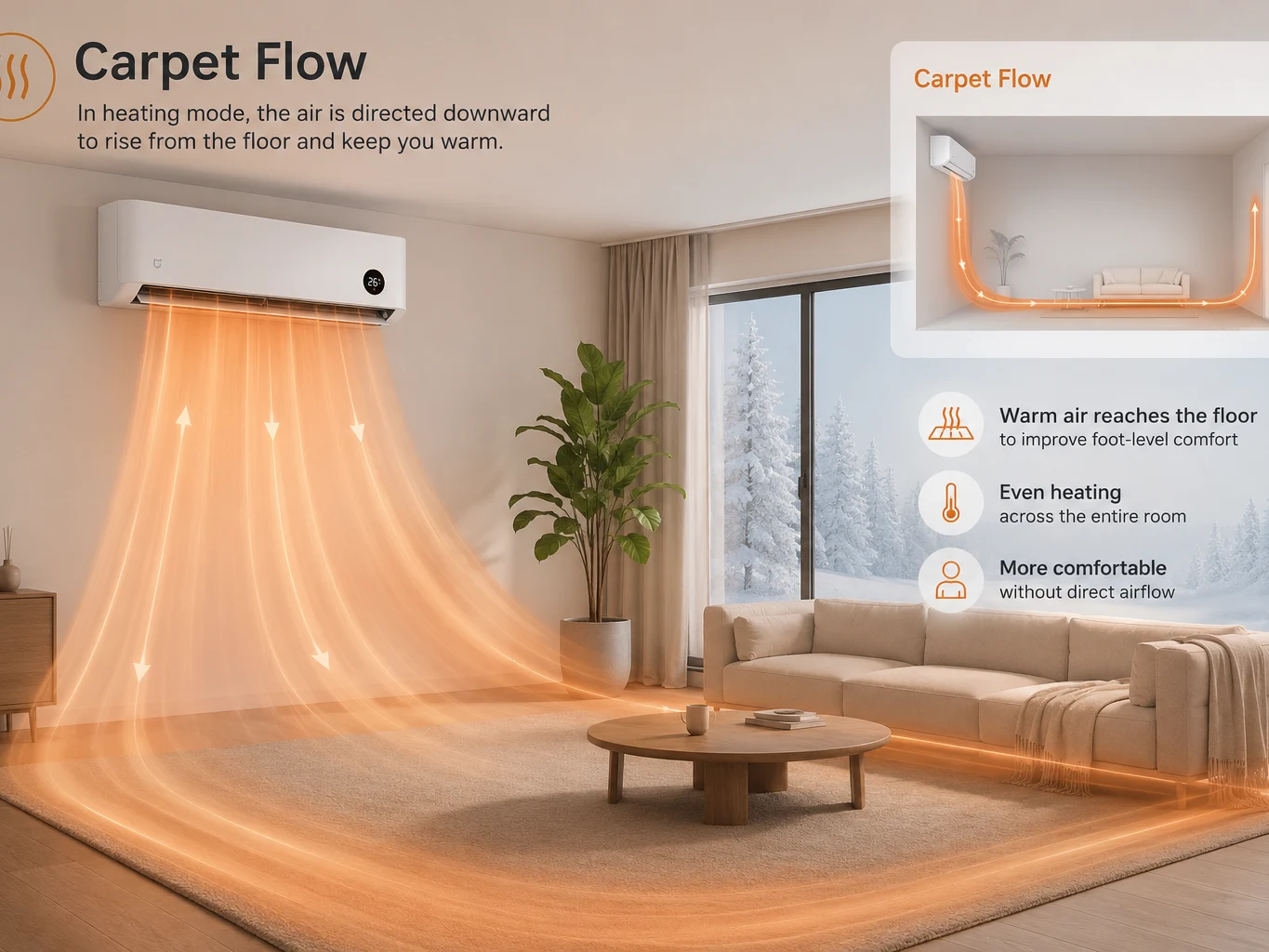
    Three types of airflow are advertised: Halo Flow, which cools in a circular manner, avoiding direct air currents; Canopy Flow, which cools from top-down for wider coverage; and Carpet Flow, which allows warm air to rise from the floor. Rapid temperature adjustment is supported, meaning that cool temperatures are supposedly reached in 30 seconds and full heating in just 60. Last but not least, the Mijia Air Conditioner GentleAir comes in capacities of 2.6 kW, 3.5 kW, 5.2 kW and 7.0 kW for living spaces of different sizes.

    Pricing and Availability

    Further information on pricing and global availability is still pending. Their is no word yet on when this might launch outside of China, or how much it will cost in other markets. The company has not provided a timeline for international sales, so interested customers will have to wait for updates from Xiaomi.

    Sources
    • New Xiaomi Smart Air Conditioner with mmWave Accessory Available

      New Xiaomi Smart Air Conditioner with mmWave Accessory Available

      Key Takeaways

      1. The Xiaomi Mi Home Central Air Conditioner offers both cooling and heating with a temperature range of -28°C to 65°C (-18°F to 149°F) and an annual performance factor (APF) of 5.75.
      2. It features smart add-ons like the Mi Home Intelligent Sensing Fan Panel, which uses mmWave radar sensors to adjust settings automatically based on room occupancy.
      3. The air conditioner includes a Health Filter that eliminates over 99% of formaldehyde, improving indoor air quality.
      4. It has a self-cleaning function at 56°C (133°F) and AI-driven health check-ups to identify potential issues with the unit.
      5. The product is priced at CNY 25,999 (~$3,762) in China, with no confirmed availability in other regions yet.


      Xiaomi has introduced the latest Mi Home Central Air Conditioner (6HP, Super Level 1 Energy Efficiency) in China. This innovative smart home appliance provides both cooling and heating, featuring a variety of advanced characteristics.

      Advanced Temperature Range

      The Xiaomi Mi Home Central Air Conditioner is equipped with a dual-cylinder compressor that uses gas injection, enabling it to function efficiently across a broad temperature spectrum of -28°C to 65°C (~-18°F to 149°F). It’s also considered to have good energy efficiency, boasting an annual performance factor (APF) of 5.75 and earning a Level 1 energy efficiency rating in China.

      Smart Features Available

      Users have the option to enhance their experience with several smart add-ons for the Mi Home Central Air Conditioner. One such upgrade is the Mi Home Intelligent Sensing Fan Panel, which incorporates mmWave radar sensors to detect people in the room and adjust its settings automatically. Additionally, the Mi Home Central Air Conditioner Health Filter is designed to eliminate over 99% of formaldehyde, thereby enhancing air quality. Moreover, the Xiaomi Smart Air Management Panel allows the device to connect with other compatible smart home gadgets. Other notable smart features include a self-cleaning function at an intelligent 56°C (~133°F) and AI-driven health check-ups that can identify clogs, low refrigerant levels, and various hardware or software problems.

      Pricing and Availability

      In China, the Xiaomi Mi Home Central Air Conditioner (6HP, Super Level 1 Energy Efficiency) is priced starting at CNY 25,999 (~$3,762). While Xiaomi already markets some smart air conditioning units in Europe, such as the Mijia Air Conditioner Pro Eco 2.6 kW (currently €599 at Mi Store ES), it’s still uncertain if this new model will be available in other regions.

      Source:
      Link


    • Smart Energy-Saving Control with Aqara W600 Thermostat for €49.99

      Smart Energy-Saving Control with Aqara W600 Thermostat for €49.99

      Key Takeaways

      1. Aqara’s Radiator Thermostat W600 enhances energy efficiency and is priced at €49.99, compatible with various radiator valve standards.
      2. The W600 features smart heating management, allowing users to set schedules, use occupancy sensors, and control the device remotely via an app or voice commands.
      3. It supports both Thread and Zigbee protocols, making it compatible with major Matter-compatible smart home systems for easy upgrades.
      4. The thermostat can manage multiple heating periods daily, modify temperatures in 0.5°C steps, and operates locally without internet access, ensuring continuous automation.
      5. Additional features include frost protection, a reversible LED display, a battery life of up to two years, and compatibility with leading smart home platforms like Apple Home and Google Home.


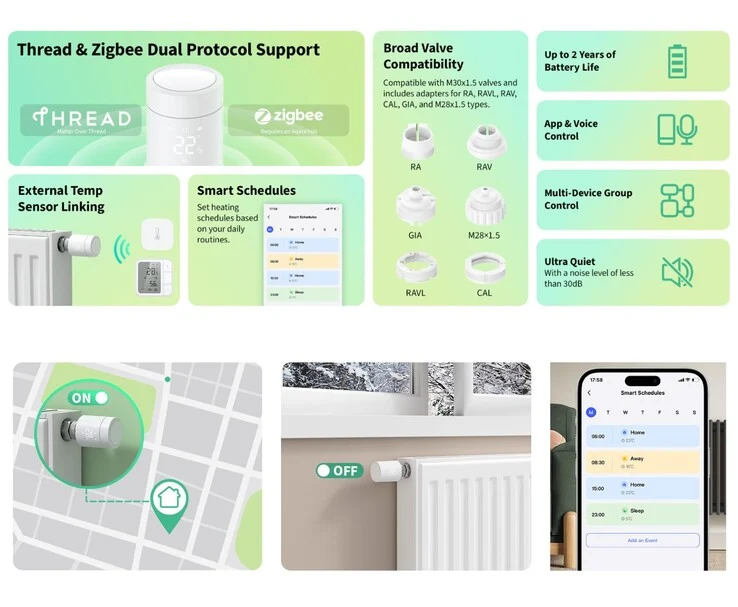
      Aqara has launched its latest Radiator Thermostat W600, a smart device aimed at enhancing energy efficiency in homes across Europe. It is currently available for €49.99 on Amazon DE and is compatible with various valve standards, such as RA, RAV, RAVL, Caleffi, Giacomini, and M28×1.5, making it a good fit for most conventional radiator setups.

      Smart Heating Features

      The W600 is designed to manage heating more effectively by making sure radiators only work when they are actually needed. Users can set up heating schedules for different rooms, use occupancy sensors, or even set geofencing rules. Additionally, the thermostat can be controlled remotely through Aqara’s mobile app, voice commands, or in combination with the Aqara Climate Sensor W100.

      Compatibility and Integration

      Supporting both Thread and Zigbee, the W600 can easily fit into major Matter-compatible smart home systems. Aqara promotes it as an easy upgrade for anyone wanting to modernize their heating without having to change their existing radiators.

      Advanced Features and User Control

      Aqara mentions that the W600 can manage up to seven heating periods each day, offering five preset modes and quick scheduling options. It allows routines to run locally through Zigbee in the Aqara Home app, ensuring automation continues even without internet access. The thermostat can modify temperature in 0.5°C steps, features calibration settings, and is compatible with external Aqara temperature sensors like the Climate Sensor W100 or FP300 for better room measurement. It also has geofencing capabilities to heat up rooms as users get closer to home and can stop heating when a sudden temperature drop is detected by connected sensors on doors or windows. Multiple units can be grouped to coordinate heating throughout different spaces, and it operates quietly at less than 30 dB.

      Safety and Power Supply

      The W600 includes additional features such as frost protection, which turns on heating if the temperature drops below 5°C. It is powered by two AA batteries, which are expected to last up to two years. First revealed at IFA 2025, the W600 comes with a reversible LED display, enhanced valve compatibility compared to its earlier models, and a dual-protocol setup that allows integration with Matter through Thread without needing a special hub, while Zigbee mode provides advanced automation options in the Aqara Home app. This thermostat is compatible with leading Matter-enabled platforms like Apple Home, Google Home, Amazon Alexa, Home Assistant, and SmartThings.

      Aqara states that the Radiator Thermostat W600 is now accessible via the company’s official site, authorized retailers, and major online marketplaces. It is also listed on Amazon in multiple European countries like France, Germany, Italy, the Netherlands, Poland, and Spain, ensuring wide availability at launch.

      Source:
      Link


    • Xiaomi Introduces Smart Air Conditioners in New Market

      Xiaomi Introduces Smart Air Conditioners in New Market

      Key Takeaways

      1. Xiaomi launched the Mijia Air Conditioner Pro Eco 2.6kW and 3.5kW models in Europe, priced at €599 and €699, respectively.
      2. Both models offer cooling and heating options with a heating capacity of 3.6 kW and an A+++ energy efficiency rating.
      3. The Mijia AI Energy Saving mode optimizes settings based on user habits and environmental conditions.
      4. The 2.6kW model is suitable for spaces of 10 to 20 m², while the 3.5kW model accommodates areas up to 25 m².
      5. Users can control the air conditioners via the Xiaomi Home app or Google Assistant voice commands.


      Xiaomi has unveiled its Mijia Air Conditioner Pro Eco 2.6kW and Mijia Air Conditioner Pro Eco 3.5kW models in Europe. These products were first seen on the company’s global website back in July 2025.

      Official Launch in Europe

      Now, Xiaomi has confirmed that the Mijia Air Conditioner Pro Eco series is available in Europe. The Mijia Air Conditioner Pro Eco 2.6kW is priced at €599, while the Mijia Air Conditioner Pro Eco 3.5kW costs €699. You can buy these units directly from Xiaomi’s online store or through selected retailers.

      Features and Efficiency

      Both Mijia Air Conditioner Pro Eco models provide both cooling and heating options, featuring a heating capacity of 3.6 kW and an impressive A+++ energy efficiency rating for both functions. This efficiency is partly due to the Mijia AI Energy Saving mode, which smartly adjusts settings according to your habits and surrounding conditions. They come equipped with a 108 mm (~4.3 inch) cross-flow fan that ensures an even air distribution. Users also have access to modes like Turbo, which can temporarily boost the fan speed. The Mijia Air Conditioner Pro Eco can be managed via the Xiaomi Home app, allowing you to monitor energy consumption and check the filter status. Alternatively, you can use Google Assistant voice commands to make adjustments.

      Model Differences

      There are some distinctions between the two models. The 2.6kW variant has a cooling capacity of 2.6kW and an airflow rate of 600 m³/h (~21,190 ft³/h), making it suitable for spaces between 10 to 20 m² (~108 to 215 ft²). On the other hand, the 3.5kW model is ideal for larger rooms, accommodating areas up to 25 m² (~161 to 270 ft²) with an airflow rate of 650 m³/h (~22,955 ft³/h).

      Source:
      Link


    • New Xiaomi Mijia Vertical Air Conditioner: Super Energy Saving

      New Xiaomi Mijia Vertical Air Conditioner: Super Energy Saving

      Key Takeaways

      1. The Xiaomi Mijia Air Conditioner Super Energy Saving Vertical 2 HP offers improved energy efficiency with a Level 1 rating and a 4.85 APF index.
      2. It features a strong air circulation volume of 1,480 m³/h, cooling down in just 40 seconds and heating in 80 seconds.
      3. The device has a wide temperature range, adjustable from -32 to 60°C, and includes a self-cleaning function.
      4. Remote control options are available through the Mijia app, and it can connect with other smart home devices.
      5. The air conditioner is priced at CNY 3,799 for pre-order, with a final retail price of CNY 4,599, and may not be available in Europe.


      Xiaomi has introduced the latest Mijia Air Conditioner Super Energy Saving Vertical 2 HP in China. This device is designed to provide impressive energy efficiency, significantly better than previous models from the brand.

      Impressive Specifications

      The product page for the Mijia Air Conditioner Super Energy Saving shows that it has a substantial air circulation volume of 1,480 m³/h (around 52,265 ft³/h). The unit boasts a range of up to 13 m (approximately 43 ft), features a 181 mm (nearly 7.1 inches) wide air outlet, and can distribute air at an angle of up to 115°. Xiaomi claims that it cools down quickly, allowing users to feel the cooling effect in just 40 seconds. Additionally, it heats efficiently with a maximum heating power of 2,100 W, providing warmth in just 80 seconds. Users can set the temperature anywhere from -32 to 60°C (roughly -26 to 140°F).

      Energy Efficiency and Features

      This Mijia Air Conditioner achieves a Level 1 energy efficiency rating in China, boasting a 4.85 APF index. It includes a self-cleaning function with higher temperature drying, and operates within a sound level of 38 to 42 dBA. The built-in display presents the current temperature and mode, while remote control options are accessible through the Mijia app. It can integrate with other smart home devices and is expected to receive over-the-air updates, supporting HyperOS Connect. The dimensions of the internal unit are 346 x 1,868 x 434 mm (around 13.6 x 73.5 x 1.7 inches).

      Pricing and Availability

      In China, the new Xiaomi Mijia Air Conditioner Super Energy Saving Vertical 2 HP is open for pre-order at a price of CNY 3,799 (about $530), with a final retail price of CNY 4,599 (approximately $642). It is worth noting that this product may not be available in Europe, as Xiaomi has not yet launched smart air conditioners in that region. However, they do offer other cooling solutions, such as the Smart Standing Fan 2 Pro, currently priced at €129 on Amazon.de.

      Source:
      Link


    • Xiaomi Unveils New Air Conditioner with Upward Airflow and Radar

      Xiaomi Unveils New Air Conditioner with Upward Airflow and Radar

      Key Takeaways

      1. Innovative Upward Airflow: The Mijia Air Conditioner Pro directs air upward for a more comfortable and ambient cooling experience, avoiding direct blasts of cold air.

      2. Human-Sensing Technology: Equipped with dual mmWave radars, the unit detects human presence and adjusts airflow direction for comfort, a feature typically found in high-end AC systems.

      3. Energy Efficiency: The air conditioner switches to low-power mode when no occupants are detected, potentially saving around 361 kWh annually, equating to about 216 yuan (~$30) on electricity bills.

      4. Smart Home Compatibility: It integrates with HyperOS Connect, Mi Home, and Xiao Ai voice assistant, allowing for personalized modes and over-the-air updates.

      5. Compact and Quiet Design: Weighing only 13kg and requiring minimal installation space, it operates quietly at just 18dB(A) in silent mode, making it ideal for various living environments.


      Last year, Xiaomi introduced an innovative concept in home cooling: an air conditioner that directs air upward rather than straight at you. This design offers a more comfortable and less intrusive airflow that gently fills the space, similar to ambient cooling but with a smarter approach. Now, Xiaomi has launched an enhanced model: the Mijia Air Conditioner Pro, featuring human-sensing upward airflow, priced at 3,999 yuan (~$550).

      Key Features of the Mijia Air Conditioner Pro

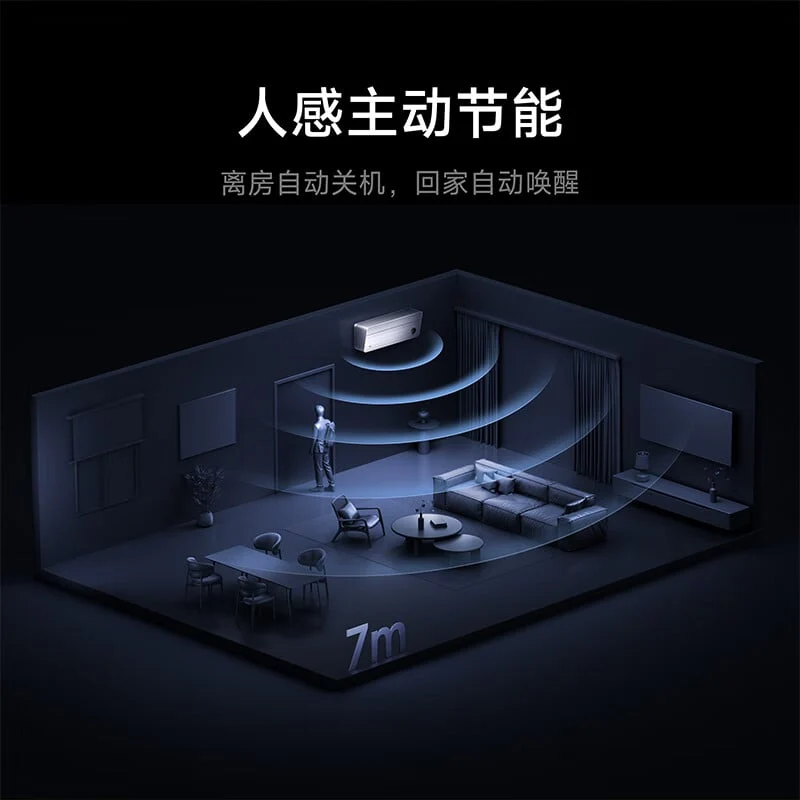
      This new unit, with a power of 1.5 horsepower, continues the “wall-hugging” airflow idea but incorporates a significant improvement: dual mmWave radars that monitor human presence in real-time. The system can identify your location within a room and can either direct cooling towards you for immediate comfort or redirect it to avoid an uncomfortable blast of cold air. This advanced technology is usually found in high-end central AC systems, now available in a consumer-friendly wall unit.

      Energy Efficiency and Smart Control

      The integration of radar technology also contributes to energy efficiency. When the system detects no occupants, it switches to a low-power mode. When someone returns, it quietly increases its output. According to Xiaomi, this intelligent feature—driven by the Lingyun AI engine and supported by cloud-based scene recognition—can save around 361 kWh each year, which is about 216 yuan (~$30) on your electricity bill.

      The Mijia Pro utilizes a dual-cylinder inverter compressor with a double-row condenser and evaporator, ensuring effective heating and cooling even in extreme weather conditions, from -35°C in winter to a sizzling 65°C in summer. It boasts an APF rating of 5.65, making it eligible for China’s top energy efficiency category, “Super Level 1.”

      Smart Home Compatibility and Design

      Xiaomi hasn’t overlooked smart home features either. This unit is compatible with HyperOS Connect and works seamlessly with the Mi Home and Xiao Ai voice assistant. Additionally, it receives over-the-air updates for new capabilities in the future. Users can personalize their favorite modes or select preset scenes based on their activities or the time of day.

      Furthermore, it includes a self-cleaning cycle at 56°C for both indoor and outdoor units, along with an antibacterial filter that eliminates over 99% of common germs. It delivers impressive airflow at 830m³/h while maintaining a quiet operation level of just 18dB(A) in silent mode—quieter than most whispers.

      On the design front, it is sleek and compact. The indoor unit weighs only 13kg and requires just 35cm of vertical space and 2cm of top clearance, offering installers greater flexibility compared to traditional bulkier wall units.


    • Xiaomi Launches AI-Controlled Central AC with High Efficiency & Purification

      Xiaomi Launches AI-Controlled Central AC with High Efficiency & Purification

      Key Takeaways

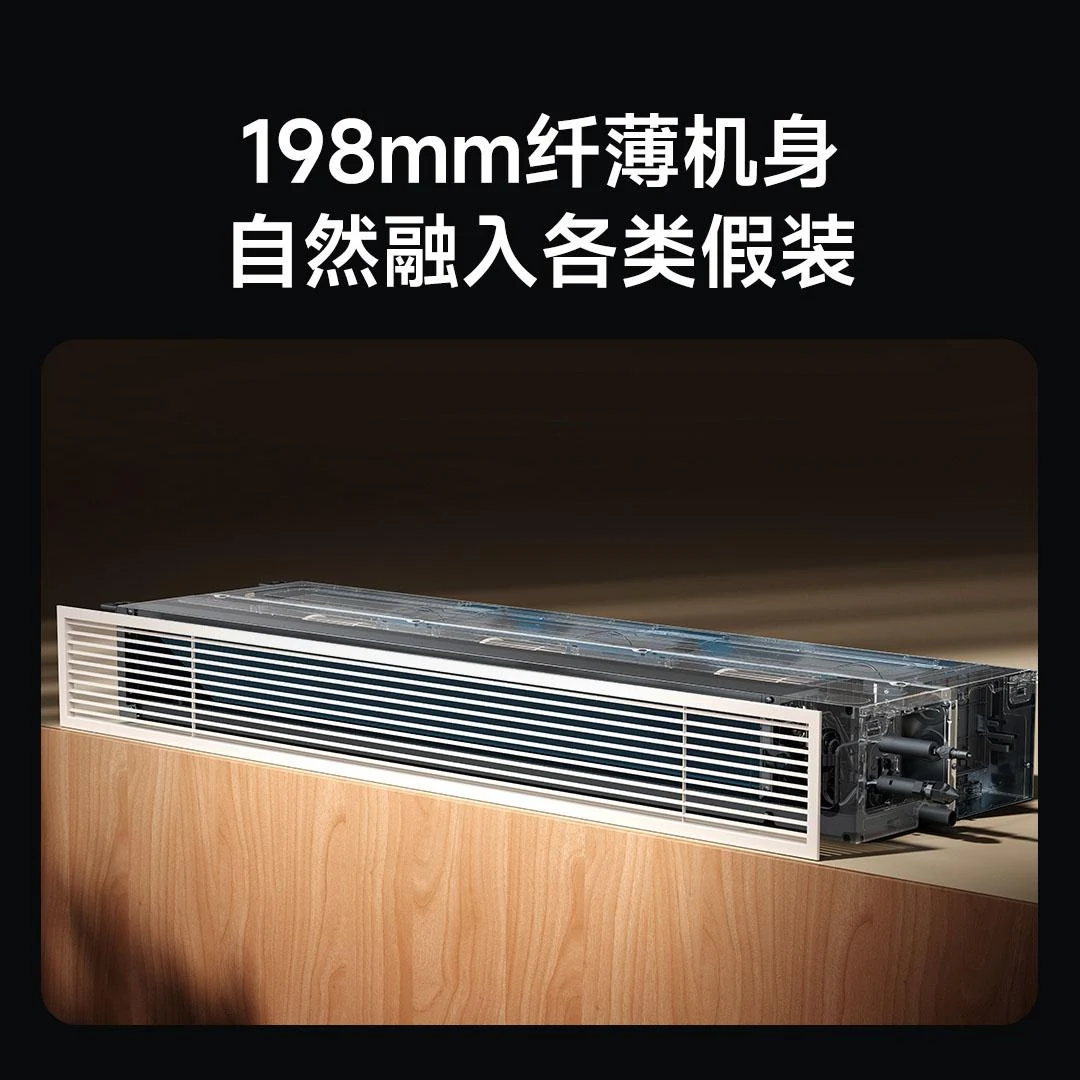
      1. Stylish Design: The Mijia Central Air Conditioner Pro has a slim profile of 198mm, designed to fit seamlessly into ceilings of medium-sized homes (40–50 square meters).

      2. High Energy Efficiency: With an energy efficiency rating of APF 4.35, the unit can save up to 2,389 kWh annually, resulting in lower electricity costs of about 1,195 yuan ($164).

      3. Smart Home Compatibility: It integrates with Xiaomi’s smart home ecosystem, utilizing the Lingyun Smart Control Engine to adjust settings based on user habits and environmental conditions.

      4. Advanced Air Management: The AC features dual mmWave radar sensors for precise airflow direction and offers various fan speeds and airflow modes for personalized comfort.

      5. Comprehensive Air Quality Control: The system supports Ion Purification and includes self-cleaning capabilities, along with connectivity to other Xiaomi smart devices for improved indoor air management.


      Xiaomi has taken a significant leap into the realm of smart home technology with its new product — the Mijia Central Air Conditioner Pro (Ducted 4 HP Ultra-Level 1 Energy Efficiency). This unit is currently available for pre-order at a price of 7,999 yuan (approximately $1,100) on Xiaomi Youpin. This air conditioning system is clearly designed for those seeking a stylish and modern solution without sacrificing performance or intelligence.

      Key Features of the Mijia Central Air Conditioner Pro

      Tailored for medium-sized residences or apartments (around 40–50 square meters), this ducted air conditioning system is crafted to seamlessly fit within your ceiling with a slim profile of just 198mm. It integrates well with various interior layouts, ensuring that there is no bulky equipment disrupting your home’s aesthetic.

      Efficiency and Performance

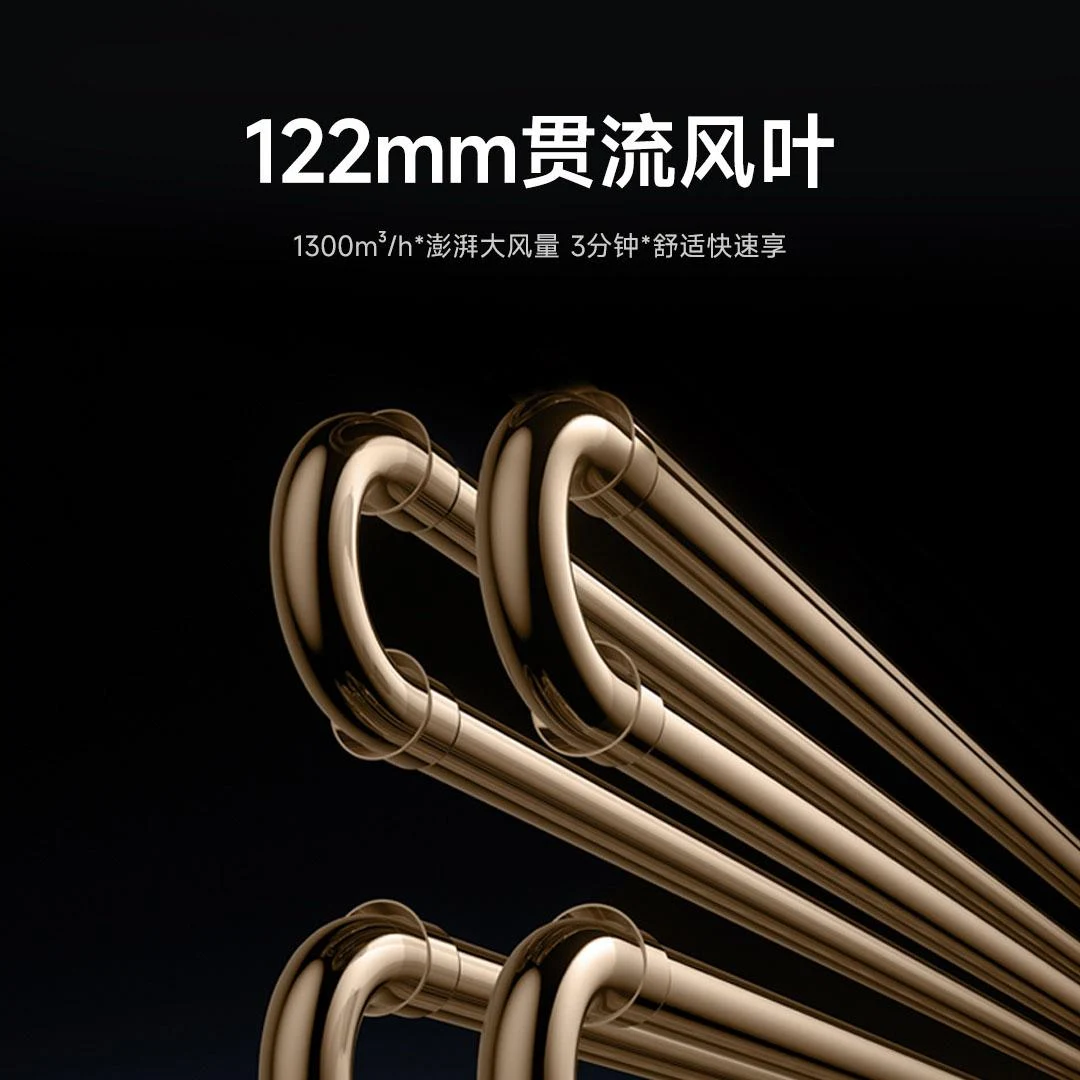
      Beyond its appealing design, the Mijia AC Pro boasts impressive energy efficiency. It holds the highest energy efficiency rating (APF 4.35), which Xiaomi claims could help save up to 2,389 kWh annually, equating to about 1,195 yuan ($164) in lower electricity costs. The unit features a dual-cylinder compressor for enhanced durability, paired with a dual-row condenser and a three-row evaporator for quicker and more effective heating and cooling. The heat exchange system utilizes 7mm copper tubes and aluminum fins, typical of higher-end models.

      Smart Home Integration

      This air conditioner is fully compatible with Xiaomi’s smart home setup. Utilizing the proprietary Lingyun Smart Control Engine, the AC adjusts to your daily routines in real-time, modifying settings based on your whereabouts, habits, and even the weather conditions. It can cool a room in just 30 seconds and heat it in 60 seconds, predicting your needs even before you interact with the app.

      The unit also employs dual mmWave radar sensors to detect your location within a 7-meter range, directing airflow accordingly. Users can select from seven fan speeds and three airflow modes: direct, avoid, or soft breeze, ensuring comfort without the need for constant adjustments.

      Comprehensive Indoor Air Management

      As part of the Xiaomi ecosystem, it is compatible with HyperOS Connect and can be controlled via the Mi Home app. Users can operate it remotely, issue voice commands through XiaoAI, and receive over-the-air updates that introduce new features over time. Xiaomi presents it as an integral component of a more holistic indoor air management system, regulating temperature, humidity, oxygen levels, cleanliness, airflow, and air quality. When paired with the optional smart air panel, it can connect to purifiers, humidifiers, and other devices.

      To ensure cleaner air, the system supports Ion Purification (requiring the optional panel) that targets PM2.5 particles, germs, and viruses. Additionally, it includes a self-cleaning capability that heats up to 56°C to sanitize both the indoor and outdoor components. There’s also a float switch that automatically powers down the unit and sends alerts if a leak is detected.


    • Xiaomi Launches Smart Standing Fan with App Control and Energy Efficiency

      Xiaomi Launches Smart Standing Fan with App Control and Energy Efficiency

      Key Takeaways

      1. Dual Functionality: The fan can be used as both a tabletop and a floor fan, offering versatility in placement.

      2. Performance: It delivers powerful airflow of up to 1440m³/h, projecting air up to 13 meters and refreshing a room in two minutes.

      3. Smart Features: The fan includes 100 adjustable speed levels, is controllable via the Xiaomi Home app, and can automate settings based on temperature.

      4. Energy Efficiency: It consumes only 1.3kWh for the entire summer and operates quietly at 27.9dB(A).

      5. User-Friendly Design: Weighing 5.7 lbs, it is easy to move, features a child lock for safety, and has a removable grille for effortless cleaning.


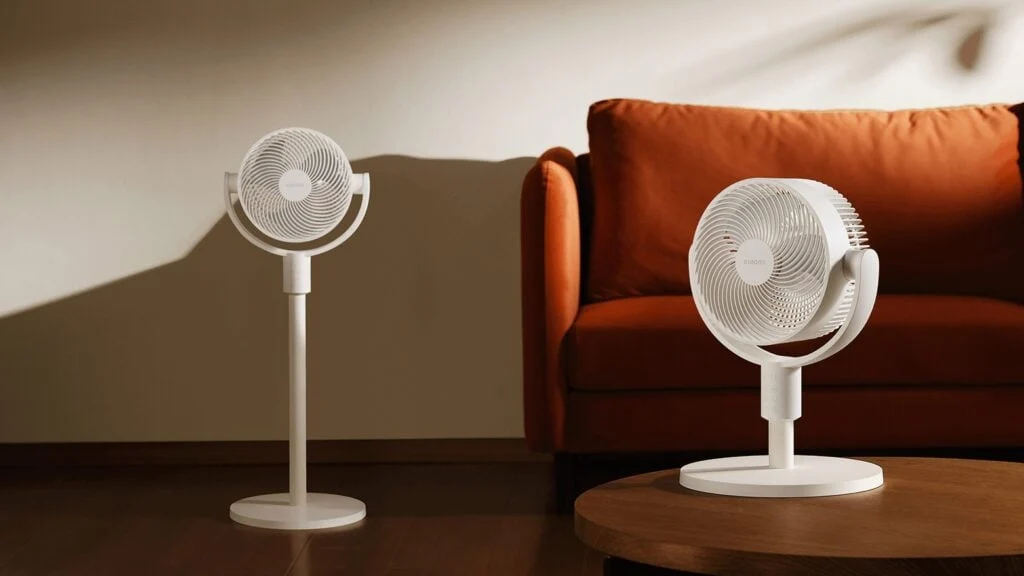
      Xiaomi has revealed its latest Smart Standing Air Circulation Fan, which functions as both a tabletop and a floor fan. This new model features smart technology, powerful airflow, and is designed to be energy efficient.

      Performance and Design

      The fan can deliver airflow reaching up to 1440m³/h and can project air up to 13 meters. According to Xiaomi, it can refresh the air in a room in as little as two minutes. With its 3D oscillation capability, moving 120° side to side and 100° vertically, it can cover an area of 538 square feet. Weighing merely 5.7 lbs, this fan’s straightforward design facilitates easy relocation between a table or floor position.

      Equipped with a DC inverter motor, this fan boasts 100 adjustable speed levels that can be accessed through the Xiaomi Home app. Users can create schedules or automate settings, such as turning the fan on when the temperature exceeds 27°C and shutting it off when it falls below 18°C. It is also compatible with other Xiaomi smart products, including thermostats, air conditioners, and humidifiers, enhancing indoor comfort. The energy usage is minimal, only consuming 1.3kWh for the entire summer, and operates at a whisper-quiet level of 27.9dB(A). For added safety, the device features a child lock and a grille that can be removed for simple cleaning without any tools. When used alongside other devices, it can assist in managing both humidity and airflow.

      Availability

      While the specific pricing is still unknown, the Smart Standing Air Circulation Fan is anticipated to be available worldwide before summer fully arrives.

      Source:
      Link

    • Linux Update Could Reduce Server Energy Use by 30%

      Linux Update Could Reduce Server Energy Use by 30%

      The shift first highlighted in a study back in December 2023 is quite remarkable. By altering just 30 lines of code, data throughput can see an increase of as much as 45% while not notably extending the processing time for each request.

      Energy Efficiency Gains

      Simultaneously, there is a notable reduction in energy usage. With computing resources being heavily utilized, a decrease of up to 30% is anticipated. Given that a vast majority of servers globally operate on Linux, this could lead to a massive amount of electricity being conserved.

      As it stands, servers and data centers are estimated to consume around 500 terawatt-hours at present, and this figure is expected to double in the coming years. A mere 10% reduction in that consumption would be enough to entirely power a smaller industrial nation, such as Denmark.

      Optimizing Workflows

      Professor Karstens, one of the authors of the study, states that these advancements don’t necessitate any modifications to the Linux kernel. The key lies in optimizing workflows to reduce the number of interrupt requests sent to the processor.

      Interrupt requests (IRQs) serve to halt program execution to redirect resources elsewhere. After that shift, the program resumes from where it was interrupted.

      However, this method proves to be quite inefficient. By adjusting the kernel, the processor’s cache can be utilized more effectively, and the volume of interrupts can be lowered considerably. Therefore, servers can operate quicker and experience fewer interruptions, especially during peak loads.

      Implementation Challenges

      That’s just the theory, of course. It’s understood that applying these changes in actual servers and data centers will require some time. With the release of version 6.13 of the Linux kernel, the anticipated modifications have been integrated and are expected to be realized in future Linux updates.

      University of Waterloo, Proceedings of the ACM on Measurement and Analysis of Computing Systems, linux.org

      Source:
      Link

    • Indoor Solar Cells Achieve 37% Efficiency in New Research

      Indoor Solar Cells Achieve 37% Efficiency in New Research

      Some researchers at the University of Kaunas, Lithuania, have created indoor solar cells with a 37% charging efficiency. Historically, converting artificial light to energy has been more challenging compared to converting solar energy. The Lithuanian research team has now developed a new type of perovskite solar cell that is highly efficient and capable of harnessing power from artificial light.

      Efficiency in Low-Light Environments

      Current photovoltaic cells struggle to function indoors where artificial light, which has a smaller spectrum and less energy, is present. Many small devices, such as smart sensors and digital clocks, operate at night when solar energy is not available. The new indoor solar cells open up many possibilities by providing power for these devices using minimal artificial light, which is almost always available at night.

      Innovative Material and Testing

      These innovative solar cells were designed to be efficient and capable of absorbing energy from a limited light spectrum. The material combines an organic semiconductor with perovskite, achieving a decent energy conversion rate. In experiments, the research team used a warm white LED with a temperature of 3,000 Kelvin, which is typical for living room lighting. This spectrum is similar to natural light but lacks infrared radiation. In addition to a special layer of perovskite, the cell uses thiazole molecules to conduct positive charges. Extensive tests showed a 37% efficiency using light from a standard LED, while the efficiency drops to 19% when using solar energy.

      Future Prospects

      There are no clear timelines yet for transitioning indoor solar cell technology into a commercial product. However, the prospects look promising that this model will eventually become a reality.


      Indoor Solar Cells Achieve 37% Efficiency in New Research