
Tag: data protection

  • AI Models Ranked on User Privacy: A Data Protection Study

    AI Models Ranked on User Privacy: A Data Protection Study

    Key Takeaways

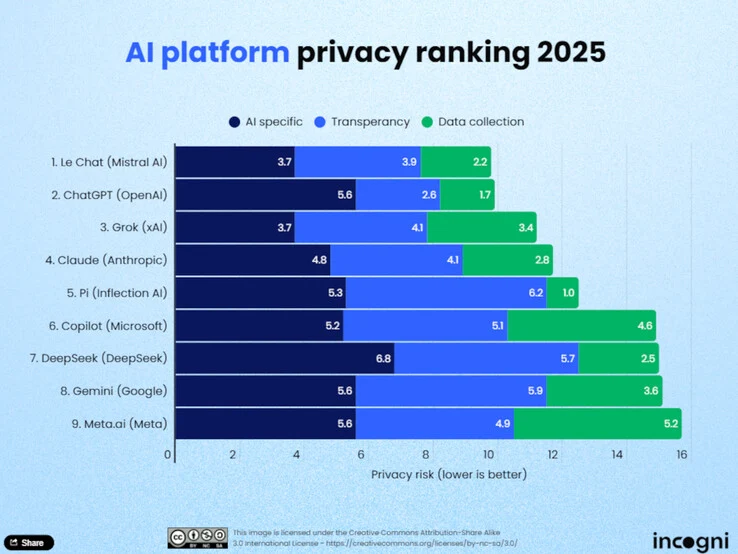
    1. Mistral AI’s Le Chat is the top model for user privacy, gathering minimal data during training and use.
    2. OpenAI’s ChatGPT ranks second, offering transparency and user options to control data usage.
    3. Grok from xAI is third, noted for its clear data protection measures.
    4. Meta AI, Google’s Gemini, and Microsoft’s Copilot score poorly due to extensive data collection and lack of opt-out options.
    5. Only four out of nine evaluated models allow users to opt out of data use for training, highlighting a need for better privacy practices in AI.


    The growing presence of artificial intelligence (AI) in our daily routines is accompanied by an increasing need for data privacy. Analysts at Incogni have recently assessed nine prominent Large Language Models (LLMs) to see which ones prioritize user privacy the most. Their evaluation is based on eleven criteria, grouped into three primary categories: data collection for training, transparency, and how data is used and shared.

    Leading the Pack

    Mistral AI’s Le Chat tops the list, according to Incogni. This model gathers relatively minimal user data, providing a highly efficient method for handling data during both training and active use. Close behind is OpenAI’s ChatGPT, which earns high marks for its transparency. Users have the option to indicate in their accounts whether their conversations can contribute to the model’s further development, and if they choose to deactivate history, their data remains unrecorded. In third place is Grok from xAI, also notable for its clear data protection measures.

    At the Bottom

    In contrast, Meta AI, Google’s Gemini, and Microsoft’s Copilot rank at the bottom. Incogni reports that these platforms gather large amounts of data while lacking clear options for users to opt out. The Chinese model DeepSeek also scored poorly, as these providers do not present straightforward ways for users to exclude their data from being used in training.

    Evaluation Criteria

    The analysis conducted by Incogni looked at platforms based on eleven criteria divided into three categories: data collection for training, transparency, and data use and sharing. The “data use and sharing” category made up 50% of the total score, with “transparency” accounting for 30% and “training data” 20%. Notably, out of the nine tools examined, only four allow users to actively opt out of having their data used for training purposes.

    The findings suggest that data protection is not universally applied across the AI landscape. Therefore, it is crucial for users to understand the privacy policies of different providers, especially when dealing with sensitive information, confidential client details, or personal data. For those who prioritize data security, options like Le Chat, ChatGPT, and Grok offer reasonable solutions. However, truly data-efficient LLMs are likely to remain rare even in 2025.

    Source:
    Link


  • German Authorities Urge Google and Apple to Remove Deepseek App

    German Authorities Urge Google and Apple to Remove Deepseek App

    Key Takeaways

    1. Deepseek has been prohibited in Italy, and German officials are taking action to remove it from Google and Apple’s platforms.
    2. Allegations include violations of EU data protection laws, particularly regarding user data transfer to China without adequate safeguards.
    3. The app collects sensitive user information, raising concerns about potential access by Chinese authorities.
    4. The Berlin data protection authority may impose fines of up to 4% of Deepseek’s global revenue, but enforcement against a foreign entity is challenging.
    5. The request to block Deepseek follows a previous warning to halt data transfers, and while it may be removed from app stores, it will still be accessible via web browsers.


    Deepseek has been prohibited in Italy, and now German data protection officials are taking action against the widely-used AI application from China. According to Der Spiegel, the Berlin Commissioner for Data Protection and Freedom of Information has filed a complaint with both Google and Apple, formally asking them to remove the Deepseek app from their platforms, making it unavailable to users in Germany.

    Allegations of Data Violations

    The basis for this request is purported violations of data protection laws, particularly concerning the transfer of user data from Europe to China. The company has not presented adequate proof that user data is safeguarded in China in a similar way as it is in Europe. According to the EU’s GDPR (General Data Protection Regulation), protecting user data is a fundamental requirement for its transfer to nations outside the EU. However, this does not ensure that other Chinese firms or the Chinese government cannot access data from European users.

    Concerns Over User Data

    This situation is particularly alarming because the chatbot app gathers a wide variety of potentially sensitive information about its users, such as text inputs, chat histories, uploaded files, location details, and device data. Chinese authorities may potentially gain access to all this information, which is already in the possession of the state for all domestic businesses.

    Possible Penalties and Future Actions

    The Berlin data protection authority has the option to impose a fine that could reach up to 4% of the company’s worldwide revenue. Nonetheless, as officials have indicated, enforcing this against a foreign entity would be a challenging task. It is worth noting that this action did not come without prior warning; in May, Berlin’s data protection officials had already set a deadline for the company to halt data transfers to China. Since the Deepseek developers failed to meet this deadline, the request for blocking has been made under the Digital Services Act. Apple and Google are now required to make a decision regarding the blocking very soon. However, the model will still remain accessible through web browsers in the future.

    Source:
    Link