Tag: AI model development

  • Nvidia DGX Spark: Compact Desktop for 1 Petaflop AI Training

    Nvidia DGX Spark: Compact Desktop for 1 Petaflop AI Training

    Key Takeaways

    1. The Nvidia DGX Spark features a powerful 20-core Arm CPU, 128 GB of LPDDR5x RAM, and 4 TB of NVMe M2 storage, achieving up to one petaflop of Tensor core performance while consuming only 240 watts of power.

    2. It allows AI developers to load large models entirely into memory, eliminating the need for model quantization or GPU VRAM swapping, which simplifies the prototyping and tuning process.

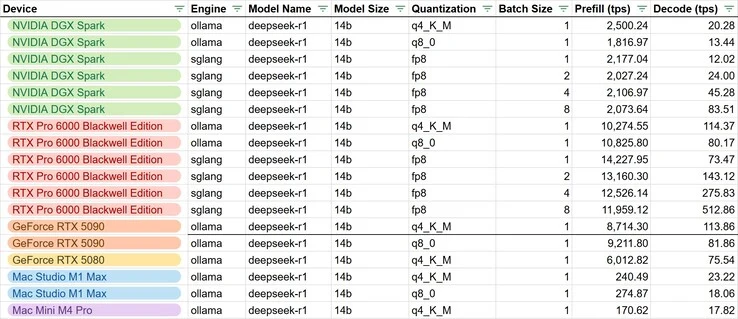
    3. Although not as fast as Nvidia’s higher-end GPUs (RTX 5080, 5090, Pro 6000), its unified RAM offers significant advantages for AI model development.

    4. The suggested retail price of the DGX Spark is $3,999.99.

    5. The DGX Spark will be widely available starting on October 15, 2025, and has been seen at Microcenter but is not yet available on the Nvidia store on Amazon.


    Nvidia has kicked off the delivery of its new DGX Spark, a compact desktop made for AI model creation.

    Specs and Performance

    This small desktop packs a punch with a 20-core Arm CPU, which includes 10 Cortex-X925 performance cores and 10 Cortex-A725 efficiency cores. It also comes with 128 GB of LPDDR5x RAM and a whopping 4 TB of NVMe M2 storage, allowing it to achieve up to one petaflop of Tensor core performance (FP4 thanks to the sparsity feature) while consuming only 240 watts of power.

    Comparison to Other GPUs

    While the DGX Spark isn’t as quick as Nvidia’s RTX 5080, 5090, or Pro 6000 GPU cards according to LMSys benchmarks, it shines with its unified RAM. This enables AI developers to load large AI models entirely into memory without needing to do model quantization or GPU VRAM swapping. This feature makes it easier to prototype and tune AI models locally and offline.

    Availability and Pricing

    The Nvidia DGX Spark has a suggested retail price of $3,999.99 and is set to be widely available beginning on October 15, 2025. It has been spotted at Microcenter, but it has yet to show up on the Nvidia store on Amazon.

    Source:
    Link


  • Huawei Chips to Power New AI Model for TikTok’s Parent Company

    Huawei Chips to Power New AI Model for TikTok’s Parent Company

    ByteDance is reportedly developing a new AI model with significant support from Huawei, which may provide the necessary hardware. The parent company of TikTok intends to utilize Huawei’s resources for training and advancing this AI initiative. Here’s what we have gathered so far.

    ByteDance Seeks Huawei’s Assistance for AI

    As per a report from Reuters, ByteDance faces challenges due to US export restrictions that hinder its ability to acquire NVIDIA chips. Initially, ByteDance’s AI project utilized NVIDIA’s H20 AI chips tailored for the Chinese market to sidestep US government restrictions. For context, the US carefully regulates which AI chips can be sold to Chinese companies to slow down the technological advancement in China.

    To navigate these obstacles, TikTok’s parent company is now looking to Huawei for assistance in training and developing its AI model. This new AI model will utilize chips from Huawei instead of NVIDIA’s offerings. This year, ByteDance has reportedly ordered 100,000 Ascend 910B chips from Huawei, but to date, it has only received about 30,000 of those units. Notably, Huawei’s Ascend 910B chips are said to outperform NVIDIA’s A100 chips in terms of GPU performance and energy efficiency.

    Challenges in Chip Supply and Future Outlook

    Despite these advantages, the development of the AI model has been hindered by chip shortages. As ByteDance tries to work around the US government’s restrictions to obtain NVIDIA chips, this development suggests a strategic move to lessen its dependence on US technology. However, it’s important to remember that this information is based on unverified reports, so it should be viewed cautiously for now. Earlier this year, ByteDance also introduced Coze, a platform akin to OpenAI, allowing users without coding expertise to create and deploy AI chatbots.