
Key Takeaways
1. NVIDIA’s G-Sync Pulsar combines variable refresh rate (VRR) syncing with advanced backlight strobing for improved motion clarity, inspired by CRT technology.
2. The technology reduces motion blur by using a rolling scan method, significantly lowering ghosting and smearing issues on high-refresh-rate LCDs.
3. G-Sync Pulsar claims to enhance effective motion clarity beyond 1000 Hz, providing a smoother gaming experience for titles like Counter-Strike 2.
4. Four new monitors featuring G-Sync Pulsar will launch, all with 27-inch IPS LCD panels, 1440p resolution, 360 Hz refresh rate, and priced starting at $599.
5. G-Sync Pulsar is not compatible with OLED displays, making it a potential solution for FPS gamers seeking better motion handling in LCD technology.
NVIDIA has recently revealed its G-Sync Pulsar, a fresh display technology that merges VRR (variable refresh rate) syncing with an advanced backlight strobing approach. Interestingly, G-Sync Pulsar draws inspiration from older CRT displays to achieve motion clarity comparable to “1000 Hz”. However, to take advantage of this, you will need a screen that supports G-Sync Pulsar and has a refresh rate of 360 Hz.
A Look Back at G-Sync
NVIDIA introduced its VRR solution under the G-Sync name in 2013, showcasing it as a helpful method to reduce screen tearing and stuttering by aligning the GPU’s frame rate with the monitor’s refresh rate.
Advancements in Technology
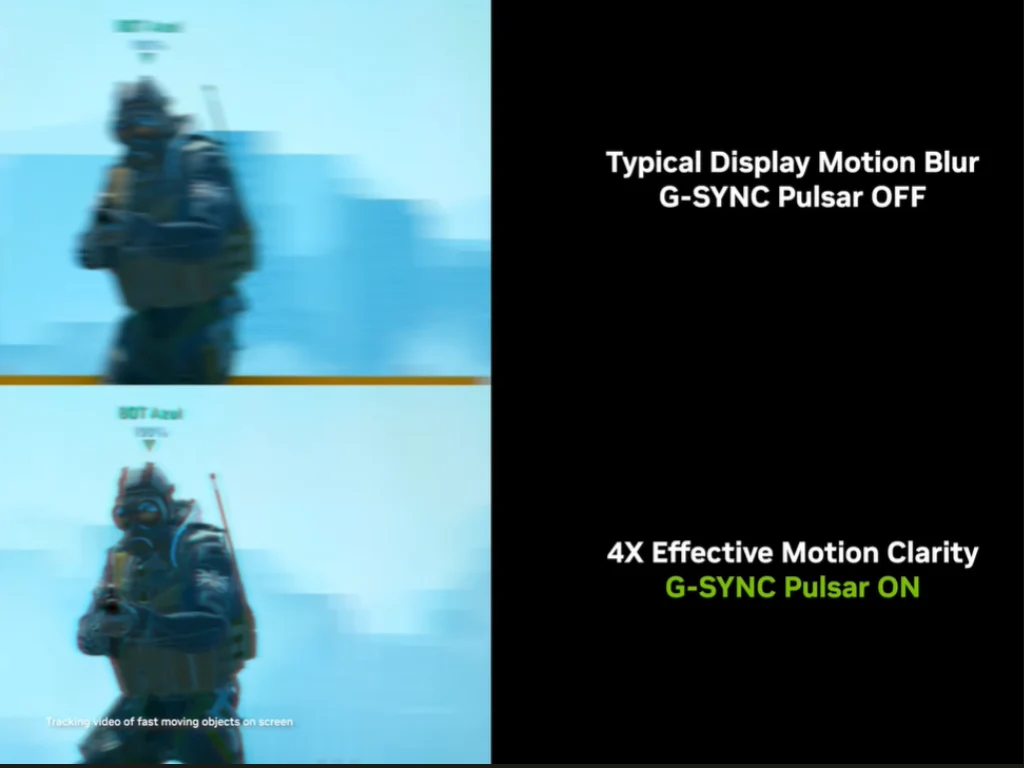
Yet, the latest G-Sync Pulsar technology takes things further by reducing motion blur even more effectively, which is quite fascinating. G-Sync Pulsar employs a rolling scan method where the backlight pulses in horizontal segments from top to bottom. It activates four times per frame, taking up almost 25% of the frame’s time.
What this achieves is allowing pixels to stabilize completely before being illuminated on the screen, which significantly lessens ghosting and smearing often seen with high-refresh-rate LCDs. G-Sync Pulsar cleverly mirrors how CRT monitors operated in the past. CRTs utilized a scanning electron beam, leading to smooth motion without the glare issues faced in modern backlighting methods.
Performance and Skepticism
According to NVIDIA, G-Sync Pulsar “enhances effective motion clarity beyond 1000Hz” on the first ASUS ROG Swift PG26 Series G-Sync gaming monitor. While some people are doubtful of NVIDIA’s new method, G-Sync Pulsar hopes to deliver a smooth experience akin to a hypothetical current-generation 1,000 Hz display, making games such as Counter-Strike 2 and Anno 117: Pax Romana appear clearer and more responsive.
In conclusion, NVIDIA’s backlight strobing technique is not exactly a novel idea but rather a progression. It has been around for a considerable time, alleviating eye-tracking blur by inserting black frames between images momentarily. This approach helped lessen pixel transitions. Nonetheless, previous versions of this method often resulted in a noticeable dimming of the screen and didn’t work well with G-Sync or FreeSync.
Competition in the Market
Asus has attempted to introduce ELMB Sync to rival Zowie’s proprietary DYAC technology, but has seen limited success, especially since DYAC remains a preferred choice for many CS2 gamers.
NVIDIA’s version of Pulsar supposedly operates seamlessly at variable frame rates starting from 90 FPS and aims to provide even better clarity than Zowie’s 2nd-generation DYAC, while also offering more flexibility compared to DYAC’s fixed refresh rate requirements.
New Monitor Launches
Four new monitors featuring G-Sync Pulsar are set to launch: Acer Predator XB273U F5, AOC Agon Pro, Asus ROG Strix Pulsar, and MSI MPG 272QRF X36. All these models come with 27-inch IPS LCD panels, a resolution of 1440p, a refresh rate of 360 Hz, and HDR support, with prices beginning at $599.
Sadly, G-Sync Pulsar isn’t compatible with OLED displays since it depends on the backlighting that LCDs provide. OLED screens can’t mimic scanline pulsing because of their display technology, and while a 540Hz OLED screen will be somewhat close, G-Sync Pulsar could be the ultimate solution for some FPS gamers for the near future, due to its superior handling of motion blur.
Early reviews from CES have been very positive, with attendees noting that they felt their eyes were no longer struggling to keep pace with fast-moving visuals.
Source:
Link