
Key Takeaways
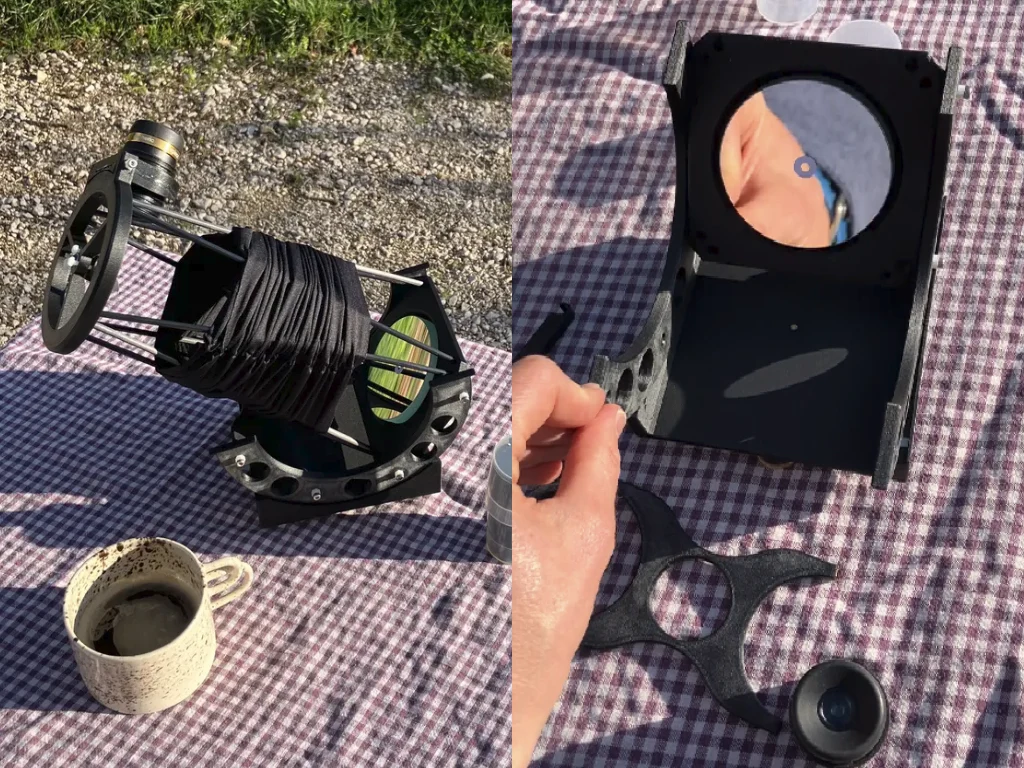
1. Compact and Portable Design: The telescope is designed to fit into a jacket pocket, featuring a 76 mm parabolic mirror and a fast f/4 optical system, making it highly portable.
2. 3D-Printed Construction: The telescope is made entirely from 3D-printed PETG carbon-fiber filament, ensuring it is both lightweight and rigid.
3. Traditional Dobsonian Mechanics: It incorporates classic Dobsonian features, allowing for smooth altitude and azimuth movements using makeshift Teflon pads and carbon rods for stability.
4. Innovative Focusing Mechanism: The eyepiece holder uses a friction-based system without extra hardware, along with a Lycra shroud to minimize light interference and dew.
5. Usable Optical Performance: After refiguring the mirror, the telescope achieved a performance of approximately 0.9 Strehl, making it functional, though not comparable to larger commercial models.
A personal endeavor shared by developer and enthusiast Lucas Sifoni on November 18, 2025, outlines the creation and evaluation of a compact, fully operational Dobsonian telescope, specifically designed for easy transport.
Design and Specifications
As per the project details, this telescope is made to fit into the inner pocket of a jacket, except for its carbon rods, which is quite remarkable. The design centers around a 76 mm parabolic mirror with a focal length of 300 mm, forming a fast f/4 optical system. The entire structure is 3D-printed using PETG carbon-fiber filament, ensuring it is rigid while also keeping the weight minimal.
Mechanical Features
The design follows traditional Dobsonian ideas, emphasizing balance, smooth operation, and straightforwardness. The altitude and azimuth movements depend largely on makeshift Teflon-style pads made from UHMW or HDPE furniture feet, which are combined with rubber backing. Carbon rods provide structural stability and are intentionally bent slightly to secure the assembly. Nylon screws are used for aligning both the primary and secondary mirrors, while magnets keep the secondary mirror fixed in place.
Focusing Mechanism
Focusing is managed through a friction-based eyepiece holder. The eyepiece fits directly into a printed tube and is held in place through plastic flexion, removing the need for extra hardware. A lightweight Lycra shroud is employed to block unwanted light and reduce dew formation on the mirrors.
Optical tests shown in the screenshots feature interferograms and star tests performed before and after the mirror refiguring process. Initial observations indicate that the mirror was notably overcorrected when first received, which is a common problem with low-cost spherical mirrors. However, after refiguring, the builder noted better star symmetry and usable performance at approximately 0.9 Strehl (indicating it achieves about 90% of the theoretical maximum sharpness for a mirror of that size), although the small mirror does limit resolution.
The project documentation clearly mentions that, while this telescope does not rival larger commercial models, it is indeed a functional optical device at a remarkably small size. The 3D files, assembly notes, and optical test results are publicly accessible for anyone interested in replicating or altering the design.
Source:
Link